
EDITORIAL
On August 5, Jeff Dean walked out of Google. He had been employee number 30, the engineer whose fingerprints sit on the systems that made internet-scale computing possible. He left with three colleagues who together carry much of modern machine learning. Their new company, Discovery Loop, has a one-sentence mission. Automate the experimental loop itself.
That sentence deserves a pause. For two centuries, the engine of progress has been a bottleneck made of people. A researcher forms a hunch, designs a test, runs it, reads the result, and forms the next hunch. Everything humanity has built, every drug and chip and vaccine, moves at the speed of that human cycle. Dean and his partners are not proposing a better tool for researchers. They are proposing to remove the researcher from the middle of the loop.
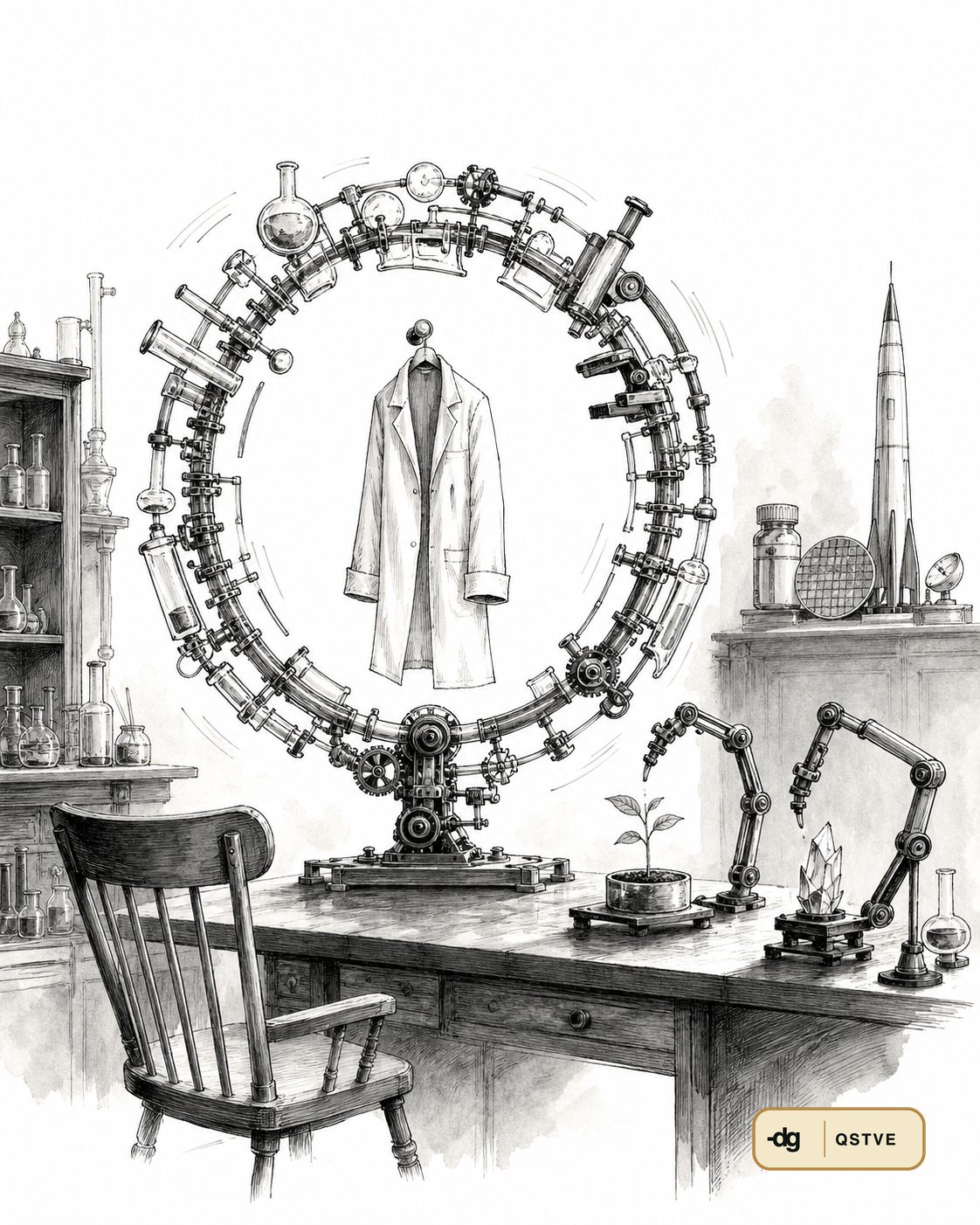
Watch the same week and the pattern sharpens. Anthropic began hiring a chip design team and signed a ten billion dollar cloud deal. Tesla and SpaceX pledged 16.8 billion dollars to break ground on a Texas chip fab they call a terafab. A lab named Mirendil signed a hundred million dollar deal with Google Cloud to scale what it openly calls self-improving AI. These are not scattered headlines. They are one wager placed on one number: how fast the distance between a question and a verified answer can be compressed.
Call it the century of the loop. In the old economy, advantage came from owning the factory, the pipeline, the network. In the economy taking shape now, advantage comes from owning the loop that improves everything else, including itself. A system that designs experiments, runs them, and rewrites its own next move does not add value in a straight line. It compounds. And whoever owns a compounding machine does not merely lead a market. They set the clock everyone else must keep.
The power lens makes this uncomfortable. Alphabet is funding the startup that its own best people left to build. That is not a contradiction. It is a confession. The incumbents understand that the loop is the prize, and they would rather own a slice of it from outside than miss it from within. The same logic explains why AI companies now want their own silicon and their own fabs. When the scarce resource stops being talent and becomes compute, you do not rent the scarce resource. You try to own the mine.
None of this is utopia, and none of it is doom. The honest reading sits in between. Automating discovery will not abolish human judgment. Someone still chooses which questions matter, which results to trust, and which doors to leave closed. But the constraint is moving. For a long time the binding limit on progress was human cleverness, which is distributed widely and cheaply across the species. The new binding limit is compute and capital, which are concentrated narrowly among a handful of firms and states. That shift should worry anyone who believes breakthroughs are healthiest when many hands can reach them.
There is a payments footnote that belongs in this story, because this brief's readers live in it. If machines are going to run experiments, they will also run transactions. That is why Visa agreed to spend 2.4 billion dollars this week to authenticate AI agents, why stablecoins went live inside Visa Direct, and why Cloudflare built a wallet wall for autonomous software. The loop needs to pay for its own compute, its own data, its own tools. The rails are being rebuilt so a program can hold a budget and spend it without a human clicking approve. The discovery machine will have a checking account.
The measure of this moment is not whether any one lab succeeds. Most will not. The measure is that the smartest builders on earth have quietly agreed on the target. Not a better search engine. Not a cleverer chatbot. The loop that makes loops. For most of history, progress waited on us. The bet now being placed, in cash and silicon and the resignation letters of famous engineers, is that it soon will not. That is either the most important thing happening in the world this week, or a very expensive way to find out we were wrong. It is worth watching which.
ZEN
Xiangyan and the sound of a pebble striking bamboo
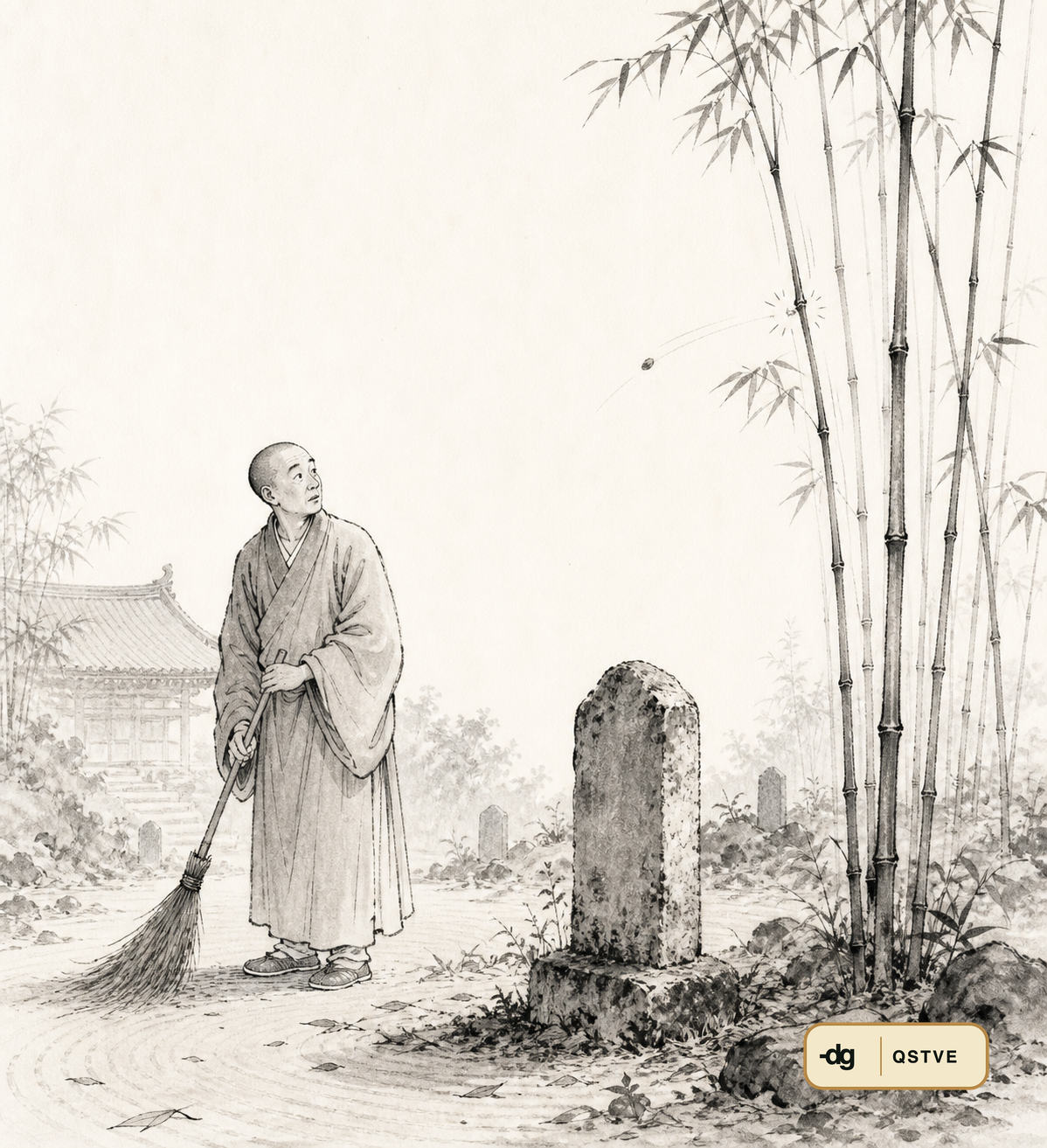
In the ninth century, during the Tang dynasty, a monk named Xiangyan Zhixian studied under the master Guishan. Xiangyan was brilliant and well read. He could answer almost any doctrinal question by drawing on what he had memorized. One day Guishan refused to accept borrowed answers. He asked Xiangyan to say one true thing about himself before his parents were born, without quoting a single scripture. Xiangyan searched his notes, found nothing that fit, and finally burned his books in frustration. He gave up the pursuit and left to tend a neglected grave site, deciding he would simply be a caretaker.
One afternoon, while sweeping, his broom flung a small stone against a stalk of bamboo. The sharp crack of pebble on wood cut through everything. In that instant Xiangyan understood what years of study had never delivered. He bowed in the direction of Guishan and thanked him, not for an answer, but for withholding one. The story is preserved in the Zen records as a teaching about the difference between knowing and seeing.
The point is easy to sentimentalize as anti-intellectualism. It is not that. Xiangyan's learning was real, and it prepared the ground. The insight is narrower and stranger. Some understanding cannot be reasoned toward by adding more information. The accumulated knowledge was not a ladder to the top. Past a point, it became the ceiling. Only when he stopped grasping, and let his attention rest fully on a plain task, did the plain task hand him what the library could not.
This lands hard in a moment obsessed with accumulation. We are building machines whose entire premise is that more data and more compute yield more answers, and for many problems that premise holds. But leaders keep hitting a different class of problem, the kind where the team already has every fact and still cannot see the move. More decks do not help. More meetings do not help. The block is not a shortage of information. It is the grip of the mind that keeps sorting information. Xiangyan's broom is a warning that the harder you clutch at the answer, the more reliably you crowd it out.
The practical lesson for anyone who builds or leads is not to stop studying. It is to know when study has done its work and something else is required. Prepare completely, then set the preparation down. The breakthrough often arrives sideways, while sweeping, when the striving mind finally goes quiet enough to hear the bamboo.
Practice for the week
Once this week, take the problem you have been chewing on the longest, the one where you already have all the facts. Stop working it directly. Spend twenty minutes on a single plain physical task done slowly and with full attention: washing dishes, walking a known route, tidying a shelf. Do not think about the problem on purpose. Just notice what surfaces on its own.