
Editorial
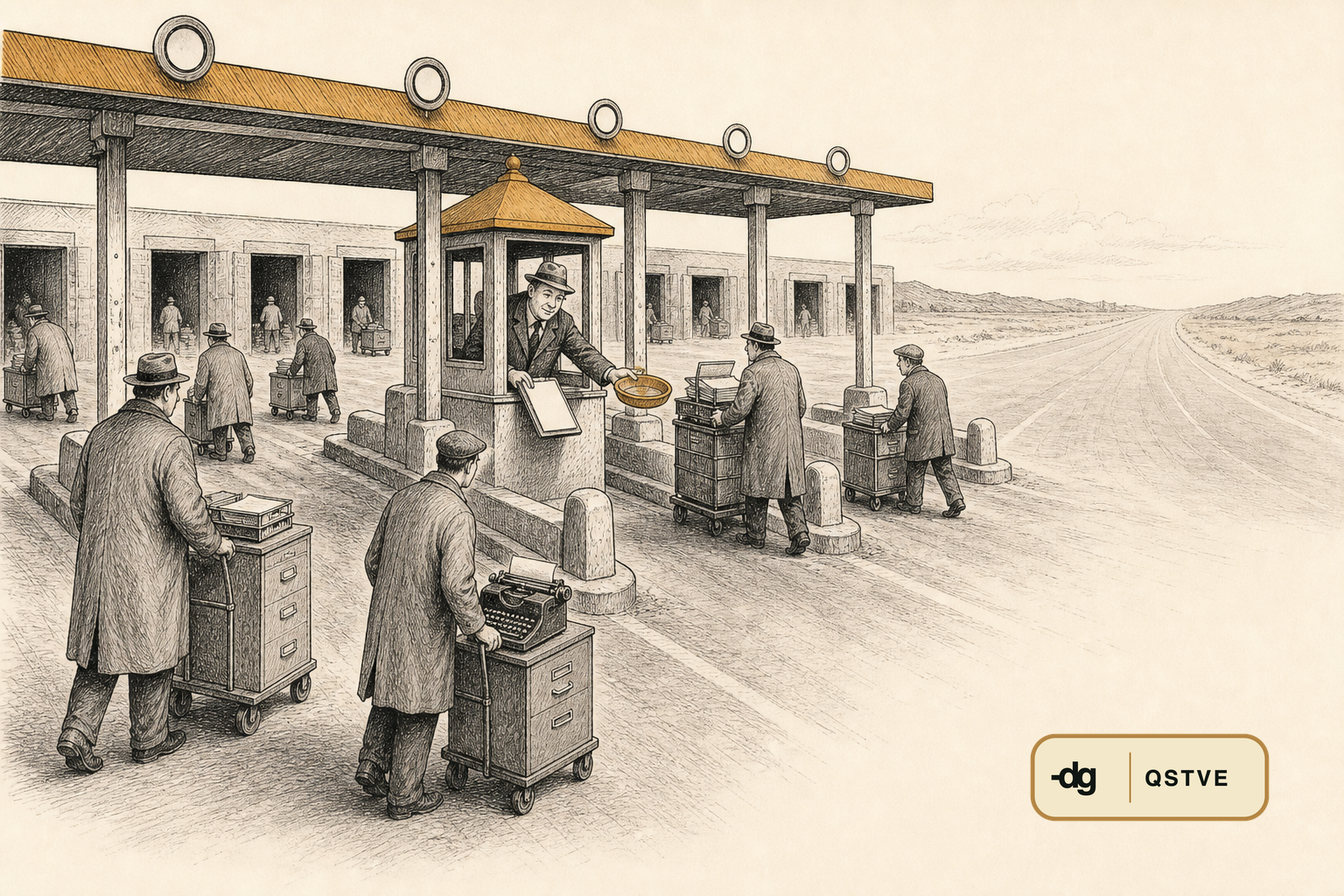
An AI agent picks a model the way a driver picks a checkout lane, glancing for the one that is cheapest and fastest at that exact second. OpenRouter is the plumbing that makes the choice. It sits between an application and dozens of large language models, sending each request to whichever one wins on price, speed, and availability. Most people who use AI every day have never heard of it. This week Stripe agreed to buy it for more than $7 billion.
The number is the headline. The shape of the deal is the story. Stripe already moves a large slice of internet commerce, and over the past year it has been quietly assembling parts that have little to do with card processing: Bridge for stablecoins, Privy for wallets, Metronome for usage billing, Tempo for blockchain settlement. OpenRouter adds the last missing piece, the layer where AI workloads get matched to models. In the annotated version of Stripe's investor letter that Lex Sokolin published Thursday, the acquisition reads as the centerpiece of a roughly $10 billion push to become, in his phrase, the economic operating system for AI companies and agents.
It helps to say plainly what that means. When software starts buying its own compute, someone has to route the request and someone has to settle the bill. Those have usually been two different companies. Stripe is betting they should be one. If agents are going to transact millions of tiny payments per day, choosing a model and paying for the tokens in the same breath, then owning both the routing and the money movement lets you collect at both ends of the same transaction. That is a real insight, and it is why the price does not look absurd to the people who wrote it.
The honest counterweight is that OpenRouter sits on thin ice. Routing between models is close to a commodity. The margins are slim, the switching costs are low, and the large labs have every reason to route their own traffic and cut the middle layer out. Nvidia already ships routing tooling; the model providers can build gateways of their own. The clearest sign of how contestable this is came the same week: Ramp, the expense-management company, launched its own model router, also called Router, aimed at the same buyers. Stripe is paying billions for a position that a well-funded rival can attack with a product shipped on a Thursday.
There is also the plainer risk of digestion. Bridge, Privy, Metronome, Tempo, and now OpenRouter are five companies with five cultures and five roadmaps, and stitching them into one coherent stack is the kind of work that looks easy on a slide and grinds for years in practice. Stripe has earned the benefit of the doubt on execution more than most. It has not earned certainty.
What is not in doubt is the direction of travel. The people who build financial rails have decided that the next great volume of payments will not come from humans tapping cards. It will come from software paying software, in fractions of a cent, at a scale no checkout line could produce. You can believe that thesis is early, or overbuilt, or priced for a world that has not arrived, and still notice that the most disciplined payments company on earth is spending real money to own the booth where that traffic will pay its toll.
The uncertainty worth keeping is not whether agents will transact. They already do. It is whether the value settles at the routing layer Stripe just bought, or slides somewhere else entirely, the way value in past platform shifts kept moving to wherever the scarce thing was. For now Stripe has decided the scarce thing is control of the road. The next year will show whether the road was the point, or whether everyone was really paying for something further down it.
Zen

Nan-in and the overfilled cup of tea
In the Meiji era, a Japanese Zen master named Nan-in received a university professor who had come to ask about Zen. The professor was an educated man, and he arrived full of what he already knew. Nan-in served tea. He poured his visitor's cup full, and then kept pouring. The tea rose to the brim, ran over the edge, and spread across the table while the professor watched, unable to stay quiet. It is overfull, he finally said. No more will go in.
Nan-in set down the pot. Like this cup, he said, you are full of your own opinions and speculations. How can I show you Zen unless you first empty your cup?
The story is easy to file under humility, as if the lesson were simply that the professor talked too much. That reading is too small. The point is not that knowledge is bad. It is that a mind already certain of what it will find has no room left to receive what is actually there. The professor did not come to learn. He came to have what he believed confirmed, and a cup that full cannot take a single drop more, however good the tea.
The teaching cuts hardest against the competent. A beginner knows the cup is empty and holds it out. It is the expert, the one with a long record of being right, who arrives so full that nothing new can land. The emptying Nan-in asks for is not ignorance. It is the willingness to set down, for a moment, the answer you walked in holding, so that the next thing has somewhere to go.
What remains after the tea is wiped up is a plain question worth carrying into any week thick with certainty and forecasts. Not what do I know, but where in me is there still room.
The Week's Best Articles
Treasury opens public comment on GENIUS Act stablecoin rules
— U.S. Department of the Treasury via PaymentsNews.com | 2026-08-17
Treasury issued a Notice of Proposed Rulemaking seeking public comment on its implementation of section 3 of the GENIUS Act, the law setting national rules for U.S. payment stablecoins. The proposal lays out Treasury's framework for what it means to issue a payment stablecoin in the United States.
The practical hinge is licensing. By defining when an issuer counts as issuing in the U.S., the rule aims to tell the industry exactly when a GENIUS license is required and when it is not, replacing guesswork with a line issuers can plan around.
The timing matters because stablecoins have moved from crypto novelty to payments infrastructure in the space of a year, with banks, neobanks, and payment networks all circling issuance. Clear licensing thresholds decide who can play and how, and the comment period is where the largest incumbents will push to shape those edges.
Ramp launches its own AI model router, called Router
— TechCrunch via The CEO Report | 2026-08-20
Ramp, the corporate expense-management platform, launched an AI model routing service called Router that lets users and companies switch between large language models through a single API.
The timing is pointed. It arrives the same week Stripe agreed to pay more than $7 billion for OpenRouter, a company that does essentially the same thing, which tells you how contestable the routing layer is and why Stripe's price raised eyebrows.
For Ramp the logic is adjacency. It already sits between companies and their spending, so extending into the spending on AI compute is a natural stretch, and it puts Ramp into direct competition with a far larger payments company on ground both now consider strategic.
AI capital spending passes oil and gas
— Chamath Palihapitiya's newsletter | 2026-08-14
AI capital expenditure hit $765 billion in 2026, passing oil and gas spending for the first time, a marker of how thoroughly the buildout has reshaped where investment flows.
That a single technology's infrastructure now outspends the energy industry says something about both the scale of the bet and its concentration, with a handful of companies and their financiers driving the bulk of it.
It also raises the question hanging over the wider economy: whether this wave of spending is building durable productive capacity or inflating an asset boom whose returns have yet to arrive, a debate now spilling into bond and equity markets alike.
Nvidia becomes the financier of the AI boom
— Bloomberg | 2026-08-17
Nvidia is priming the AI pump, with Wall Street helping it help customers buy more of its chips, including a reported $1.5 billion investment in a SoftBank data-center developer behind an OpenAI project.
The arrangement blurs the line between chipmaker and bank. When the dominant supplier also helps finance its buyers, it sustains demand for its own hardware and knits the whole industry's fortunes more tightly to its own.
It is a powerful engine while it runs, and a source of concentration risk if it falters. Critics see echoes of vendor financing in past booms, where a supplier propping up its customers can amplify both the upside and the eventual unwind.
Tether's first real audit still leaves a gap
— Fintech Confidential | 2026-08-19
KPMG signed off on Tether's full 2025 financials on August 13, confirming a $6.814 billion reserve surplus, a milestone for a company long criticized for opacity about what backs the world's largest stablecoin.
The catch is what is still missing. The underlying report has not been made public, and the buffer being cited has already changed since the period audited, so the headline of a completed audit carries an asterisk on both disclosure and timeliness.
It matters because Tether sits at the center of crypto markets and, increasingly, of stablecoin payments. A genuine audit narrows the credibility gap; a partial one keeps the questions alive just as U.S. rules under the GENIUS Act take shape.
Slack launches collaborative vibe-coding channels
— The Verge via The CEO Report | 2026-08-20
Slack introduced Slack Code, dedicated channels where teams can build software together with AI agents instead of jumping between separate tools and conversations.
The launch includes project-specific code channels, features that compare coding changes, and previews of HTML output before a project ships, pulling agent-assisted development into the place teams already talk.
It is also a defensive move. With Jack Dorsey's Buzz and others positioning agent-native workspaces as a threat to Slack's dominance, bringing coding agents into the daily workspace is Salesforce's bid to keep developers from drifting elsewhere.
Chinese labs bet cheap prices can overcome trust
— The Deep View | 2026-08-17
Chinese model developers are wagering that low prices can win business despite doubts about trust, pushing discount AI with releases spanning Qwen 3.8, GLM 5.3, and DeepSeek V4.
The strategy leans on aggressive pricing and open weights to pull in developers and enterprises weighing cost against the premium and the caveats that come with frontier Western models.
Ramp's own data, cited elsewhere this week, showed open-source models gaining traction with businesses, evidence the price-first approach is finding buyers even as questions about provenance and reliability linger.
Running AI agents could cost 5x more by 2028
— The Deep View | 2026-08-18
A widely shared analysis projected that the cost of running agentic AI will rise roughly fivefold by 2028, as agents consume far more tokens per task than single chatbot queries.
The math matters because agents chain many model calls together, and that compounding is where the expense hides. What looks cheap per call becomes steep at the scale of always-on automation.
It reframes the agent gold rush around unit economics, and it helps explain why so much of this week's news, from Stripe's routing acquisition to Google's cheaper Gemini, circled the question of who controls and prices the compute underneath.
Google bets a cheaper Gemini can win on economics
— The Deep View | 2026-08-14
Google cut the price of Gemini 3.7 Flash, wagering that cost can be its edge as the market shifts from raw capability toward what enterprises will actually pay to run at scale.
The move slots into a broader price war, alongside cheap Chinese models and rising worries about agent running costs, in which affordability is becoming as decisive as benchmark scores.
For Google, competing on economics plays to its infrastructure strength, and it pressures rivals whose frontier models cost more to serve just as buyers start scrutinizing the bill.