Editorial
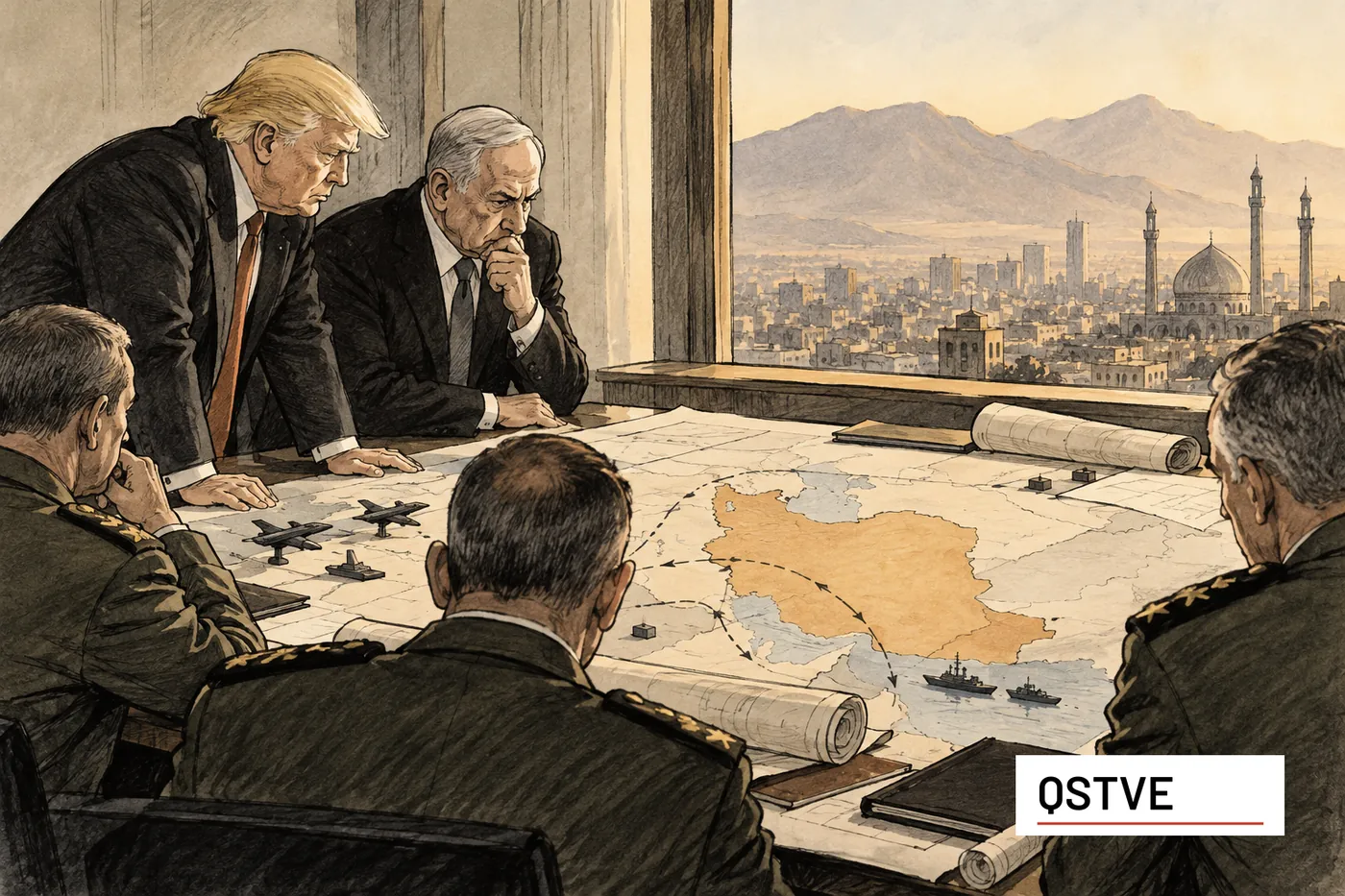
The United States and Israel are again drawing up plans for strikes on Iran. ABC News and NPR reported on October 22 that possible action was being considered for after the US midterm elections. Both accounts rely on unnamed sources. Neither says a final decision to attack has been made. For now, the news is about preparations, and about what those preparations might be intended to do.
A military plan can have more than one audience. It gives commanders an option if leaders choose to fight. It also sends a message to the other side before that choice is made. NPR’s source allowed for precisely this possibility: the preparations could be meant to push Iran toward a deal. The same activity can therefore be read as a step toward war or as an effort to avoid it. From outside the room, the two can look much alike.
The strongest case for keeping that option open is straightforward. A threat may carry less weight if there is no plan behind it. Waiting can carry costs too, especially if leaders believe a danger is growing. Readiness may give talks force they would otherwise lack. Even so, a plan answers how an attack could begin more readily than it answers how the conflict would end. A destroyed target can leave the dispute around it very much alive.
The money side of the story is already moving, though it needs careful reading. In its October 22 market report, the Associated Press described global declines led by AI stocks, with worries about spending and debt weighing on the trade. Oil rose amid fears about Iran. The US market was mixed: most stocks rose, and the Dow edged higher. Investors were pricing several worries at once. A falling index cannot tell us which one mattered most to every buyer and seller.
Oil offers a more direct route from a military threat to an everyday bill. If fighting interrupts fuel supplies or shipping, firms may face higher costs and pass some of them on. Prices can also move while traders are still weighing the chance of a shortage. A household far from the conflict can feel that uncertainty at the pump before anyone knows whether the feared disruption will arrive. That is a possible path, rather than a forecast of what every price will do.
There is a cost to reading all of this too neatly. Treat every preparation as proof of war, and the possibility of a diplomatic purpose disappears. Treat it only as pressure for a deal, and the danger of an actual strike slips from view. The difficult judgment lies in holding both possibilities open while asking what new evidence would distinguish them.
The reports leave us with a narrower conclusion than the headlines might suggest. Military action is being planned; its purpose and eventual use remain unsettled. The election gives the story a date to watch, but it tells us little about whether force would achieve its aim. What matters is whether the plan opens a path to a settlement, and what would remain if the first strike failed to bring one closer.
Zen

Zhaozhou and the empty rice bowl
A monk has just entered a monastery. He comes to Zhaozhou, the Zen teacher also known as Joshu, and asks to be taught. Zhaozhou asks whether he has eaten his rice porridge. The monk says he has. Then, the teacher tells him, he should wash his bowl. In this case from The Gateless Gate, the monk awakens at those words.
It is a small exchange, almost too ordinary to hold the weight the story gives it. The monk has come looking for instruction, and there is his bowl, still waiting after breakfast. Zhaozhou offers no long account of wisdom. He points to something close enough to touch.
There is a familiar hope in the monk’s request. We often imagine that understanding will arrive as something larger than the life already in front of us. A better answer, a clearer state of mind, a moment in which the scattered pieces finally settle. Meanwhile, the cup sits on the table and the water is running in the sink. Ordinary life has a way of remaining ordinary while we wait for it to become something else.
The bowl does not explain what the monk saw. It leaves room for the thought that attention need not wait for a grand occasion. A meal has ended. Something remains to be cared for. There can be tenderness in giving that small thing its due, without asking it to make us wiser or better.
Soon the bowl will be empty and back in its place. It will hold another meal. The story leaves us beside it, with very little to carry away and something familiar to see again.
The Week’s Best Articles
Western Union connects money transfers to stablecoins
FinTech Global | October 20, 2026
Western Union is working with Noah to connect its money-transfer network to stablecoins, digital tokens designed to hold a steady value. FinTech Global reports that the service would let a sender use Western Union’s network while a recipient receives its dollar-linked token in a wallet.
The attraction is the bridge between a familiar cash network and digital dollars. Whether it improves a transfer will depend on the fees, access and features available to that customer. The report does not establish a measured saving in time or cost, and says the token has neither US government backing nor federal deposit insurance.
Growing payment services need clear owners
PYMNTS / WEX report | October 22, 2026 in the weekly source packet; publication date not confirmed in the captured article
A PYMNTS report with WEX looks at what happens when payments built into another company’s software begin to grow. More customers, markets and ways to pay bring more fraud checks, rules and daily work. The service that handled a quiet launch may need a different level of support once it becomes part of customers’ routines.
The report’s central question is who owns that work. Someone must respond when a payment fails, keep controls current and decide what belongs with the business or its provider. This is industry analysis produced with a commercial partner. Its practical point is that growth makes any gaps in responsibility harder to ignore.
Treasury teams weigh AI as experienced staff retire
PYMNTS, interview with Katherine Weislogel of Fifth Third | October 19, 2026
Katherine Weislogel of Fifth Third describes a client whose back-office employees had spent an average of 30 years in their roles and were nearing retirement. The company was unsure who would take their places. Her account gives a concrete reason for the interest in AI that can help keep invoices, cash records and payments moving.
Much of that work rests on knowledge people have gathered over years: which exceptions matter, what needs a second look and whom to call when something goes wrong. An AI agent, software that can carry out steps in a task, needs that knowledge and clear limits on its role. Weislogel expects human checks to remain, including over permission to move money. Her example describes one client’s problem, rather than measuring a shortage across the economy.
Salmon announces $140 million in financing
Salmon, company announcement | October 19, 2026
Salmon says it has secured $140 million in financing to expand its banking and lending business in the Philippines. Its plans include growing credit-line and in-store loans, along with a wider rollout of motorcycle and small-business lending. The announcement describes financing without establishing that the whole amount is an equity investment.
The money gives Salmon more room to pursue those plans. The harder test comes as the loan book grows: whether the company can reach more borrowers while keeping credit checks and collections sound. The announcement sets out the company’s ambitions; it does not provide an outside assessment of loan quality or customer outcomes.
Banks can miss the cost of a valid payment stopped
Marcia Klingensmith, The Instant Edge / Payments Maven | October 21, 2026
Marcia Klingensmith asks what a bank learns after it stops a legitimate instant payment. The fraud team may know why a control acted. Somewhere else, a customer may be trying to pay an overdue bill or finding another way to send the money. Those two sides of the same decision can end up in separate records.
Her practitioner analysis makes a case for following the payment beyond the initial stop. Some holds are justified by account limits, policy or a need for more checks, and a successful retry does not by itself prove the first decision was wrong. Connecting the decision with what happened afterward would give banks a fuller picture of both protection and inconvenience.
Robinhood interview explores a wider role for AI
Fintech Wrap Up, interview with Jordan Sinclair | October 16, 2026; earlier analysis, not a launch this week
Robinhood UK President Jordan Sinclair discusses a business reaching beyond stock trading into crypto, digital tokens, prediction markets and AI-assisted investing. Fintech Wrap Up places the company alongside Revolut and Coinbase in the contest to become a customer’s main financial app.
The interview leads to a larger question: if an agent can research an investment and place a trade, how much of the app does the customer still need? The article reports US agent-trading features, whose access rules and limits were not independently tested for this edition. Its question is about where investing might go, while safe delegation of a portfolio remains a separate challenge.
Separate teams report major flaws in PHP
AINews / Latent Space | October 22, 2026
AINews reports that separate teams found major flaws in PHP, a language used to run websites. It describes work by Ryan Austin at Calif using an OpenAI model in the Patch the Planet program, alongside a separate discovery by Wiz. The response involved several parties working on fixes and protections.
The account includes researchers’ reports of attacks that could run code or expose memory. Those claims were not reproduced for this edition, and the report does not establish that every PHP site faces the same exposure. PHP’s wide use makes the findings important; assessing a particular site’s risk still depends on the software and fixes it actually runs.
A finance dashboard demo puts data checks first
AI In Finance / finstory AI, Wouter Born | October 16, 2026; earlier demonstration, with an October 8 beta date reported
Wouter Born tests Claude Dashboards using Google’s public set of synthetic store records. One prompt builds a dashboard. A second asks whether sales growth means the business is healthier. The tool identifies a possible stock-record problem and flags it for review, leaving the finding open for someone to check.
The article says each chart shows its database query, the instructions used to retrieve the data, and its last refresh time. That makes the result easier to trace. The two-prompt demonstration uses made-up business records, so the apparent inventory problem is no firm’s booked loss. The public preview supports this account; the paid instructions were not inspected.
A model keeps much of its quiz score but loses its writing
Nir Diamant, DiamantAI | October 19, 2026
Nir Diamant reports removing a quarter of the layers from Mistral 7B, an AI model, and giving it the same 700 multiple-choice questions. Its score fell from 66 percent to 61 percent. Asked for Australia’s capital without answer choices, however, it produced broken text and stopped. Other short writing tests failed too, according to his account.
The gap matters because selecting an answer and writing one test different skills. A score that looks fairly steady can miss a serious loss in the ability a person wants to use. This was one model in a compressed 4-bit form, without new training after the cuts. The experiment was not independently repeated for this edition, so its finding should stay tied to that test.
OpenAI proposes stronger controls for advanced AI
OpenAI Global Affairs, company policy newsletter | October 22, 2026
OpenAI is calling for stronger safeguards as AI becomes more capable. Its proposals include effective shutdown controls when lesser steps cannot deal with unsafe conditions. Depending on the risk, that could mean stopping training, removing an agent’s access to tools or suspending a service. It also supports serious-incident reporting and outside technical checks.
These are proposals from a company with a stake in the rules, rather than proof that the rules are in force or its controls work. The same newsletter discusses election images and data-center campaign ads. Together, the items show the concerns OpenAI wants policymakers to address, and the case it is making for its preferred response.
See you next week,
-dg