
I saw the image in my feed and my stomach dropped.
It showed an older man and a machine bent over the same problem, with a warm line of light running between them. It wasn’t my picture, but it looked like it belonged in the visual world I had spent months building for Man & Machine. My first reaction was immediate and territorial: someone had taken it.
That reaction didn’t last long, because I went and looked.
The image was by Volodymyr Pavlyshyn, who writes Sovereign Agentic AI on Substack. I pulled his archive and worked through the chronology. Dense engraved illustration appeared in his work in October and December 2025. Historical figures, machinery, diagrams and selective orange light were already recurring elements. Explicit human-and-robot compositions appeared by January 2026. The Kant image that unsettled me, published on 2 August 2026, really was close to some of my compositions. But it came at the end of his own visible progression, not as a departure toward mine.
I found no evidence that he copied me. I found no shared prompt, reused seed or causal link. What I found was more interesting and, in some ways, more unsettling: two people starting in different places and arriving in the same neighborhood.
The resemblance arrived all at once
This felt like the penny problem again, only in a different form.
The convergence didn’t happen on the day I saw the Kant image. It accumulated over ten months while neither of us was watching. Engraving, orange illumination, technical diagrams, machinery, an older thinker, then a human and a machine sharing one workspace and one pool of light. Each element arrived separately. None of them meant much on its own.
Then the final combination appeared, and I experienced the whole progression as one event.
That is how compounding often looks from the outside. The process is gradual, but recognition is sudden. We notice the last doubling because that is the one that finally becomes large enough to feel.
Creation will survive. Exclusivity may not.
My first instinct was the dramatic one: nobody will be able to create or own anything because continuous improvement will eventually collapse everything into the same set of answers.
I still understand the feeling behind that claim, but I don’t think it survives contact with the facts. People will keep creating. They will still own particular images, essays, songs and inventions. Copyright can protect a specific work, even if the boundaries around AI-assisted creation remain contested.
What may be disappearing is something less formal and more economically important: exclusivity. It is the practical ability to occupy a creative territory, to be recognized by a style, or to make another competent artifact valuable simply because competent artifacts are scarce.
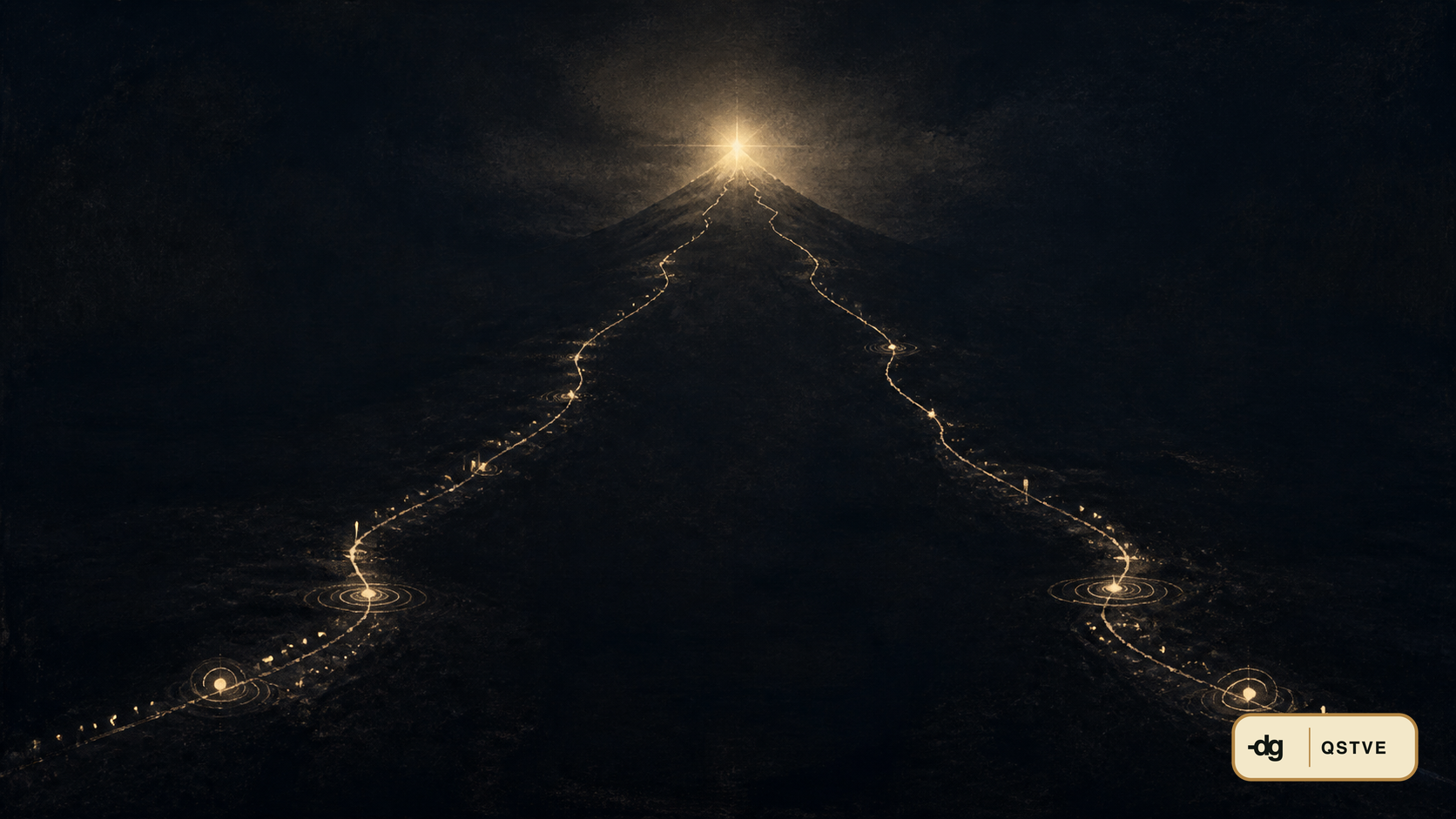
The mechanism doesn’t require theft. We are drawing from overlapping culture, using many of the same foundation models and tools, and responding to similar signals about what works. We keep the choices that produce good results, discard the ones that don’t, and carry those lessons into the next attempt. Thousands of people and machines are climbing across roughly the same landscape. It would be strange if none of us reached the same hill.
Volodymyr didn’t copy me. We were both optimizing, independently, toward a similar attractor.
What provenance can actually do
There was a period when blockchain seemed to offer a clean answer to digital ownership. NFTs, or non-fungible tokens, promised to make a digital work identifiable and ownable by linking it to a unique record on a blockchain: hash the file, timestamp it, sign it and prove it is yours.
The technology can do much of that. The larger promise of NFTs was the problem. A provenance record can establish that a particular file existed at a particular time and came through a particular workflow. It cannot stop someone who never saw that file from producing something strikingly similar. It can authenticate the house. It cannot grant ownership of the neighborhood.
The distinctions matter. A visible maker’s mark, like my -dg | QSTVE, tells the reader who stands behind the work. A cryptographic record can verify the exact file and its lineage. Copyright and trademark determine which rights exist. Platforms and courts determine whether those rights have practical force.
Those are separate jobs. A hash is evidence, not enforcement.
That leaves me with a smaller claim than the one I wanted, but probably a more useful one. We may not be able to own the neighborhood. We may still be able to prove the path we took through it.
Then the same question moved into my own work
I run persistent AI agents. They operate across different underlying models, and I replace those models when better ones become available.
That creates a question I can’t resolve by looking at the output: when the model underneath Oscar changes, is it still Oscar?
A successor model can follow the same instructions and produce work that looks continuous. But if output is becoming less distinctive, similarity of output cannot establish identity. Continuity has to live somewhere else: in the constitution the agent follows, the state it carries forward, the permissions it has, the corrections it has absorbed and the authorised chain of changes connecting the current version to the one that came before.
This is the provenance problem again, one level higher. The question is no longer, “Did you make this file?” It is, “Are you still you?”
Cryptography may help answer the technical part. A signed record can show that a state existed, that an upgrade was authorised and that a successor descends from an earlier version. But a blockchain does not contain the agent or keep it alive. Real continuity still requires stored state, recovery rules, compatible hosts, controlled keys, security boundaries and someone willing to pay for the system to continue running.
Even then, technical continuity doesn’t settle the philosophical question. Nor should persistence become a claim to immortality. I need to retain the right to correct, suspend or shut down the systems I create. Privacy, security and human authority matter more than preserving every state forever.
Which day are we on?
The version of the singularity that worries me most may not begin with one machine visibly vaulting past humanity.
It may begin with millions of humans and machines improving together, learning from the same successes and gradually becoming less able to produce meaningfully different answers. Not one mind arriving, but many minds converging.
I don’t know that this is where we are headed. One visual resemblance doesn’t prove a civilization-scale pattern, and I don’t want to turn an honest mistake into more evidence than it can carry. Taste, embodiment, local experience, relationships and sheer human contrariness still pull us in different directions. Some systems will be built specifically to search for novelty rather than the most likely answer.
But I did feel a small version of convergence happen. My first response was to accuse a stranger in my own mind. The archive corrected me. He had been climbing from his side while I climbed from mine, and we met at the top.
If that starts happening everywhere, provenance will help us remember where we came from. It may not be enough to keep us apart.
References
- Volodymyr Pavlyshyn, “The Hidden Art of Knowing: Kant’s Schematism and the Conditions of Possible Agency” — https://volodymyrpavlyshyn.substack.com/p/the-hidden-art-of-knowing-kants-schematism
- Volodymyr Pavlyshyn, Substack archive — https://volodymyrpavlyshyn.substack.com/archive
- U.S. Copyright Office and U.S. Patent and Trademark Office, Non-Fungible Token Study — https://www.copyright.gov/policy/nft-study/
- Coalition for Content Provenance and Authenticity, C2PA and Content Credentials Explainer — https://spec.c2pa.org/specifications/specifications/2.4/explainer/Explainer.html