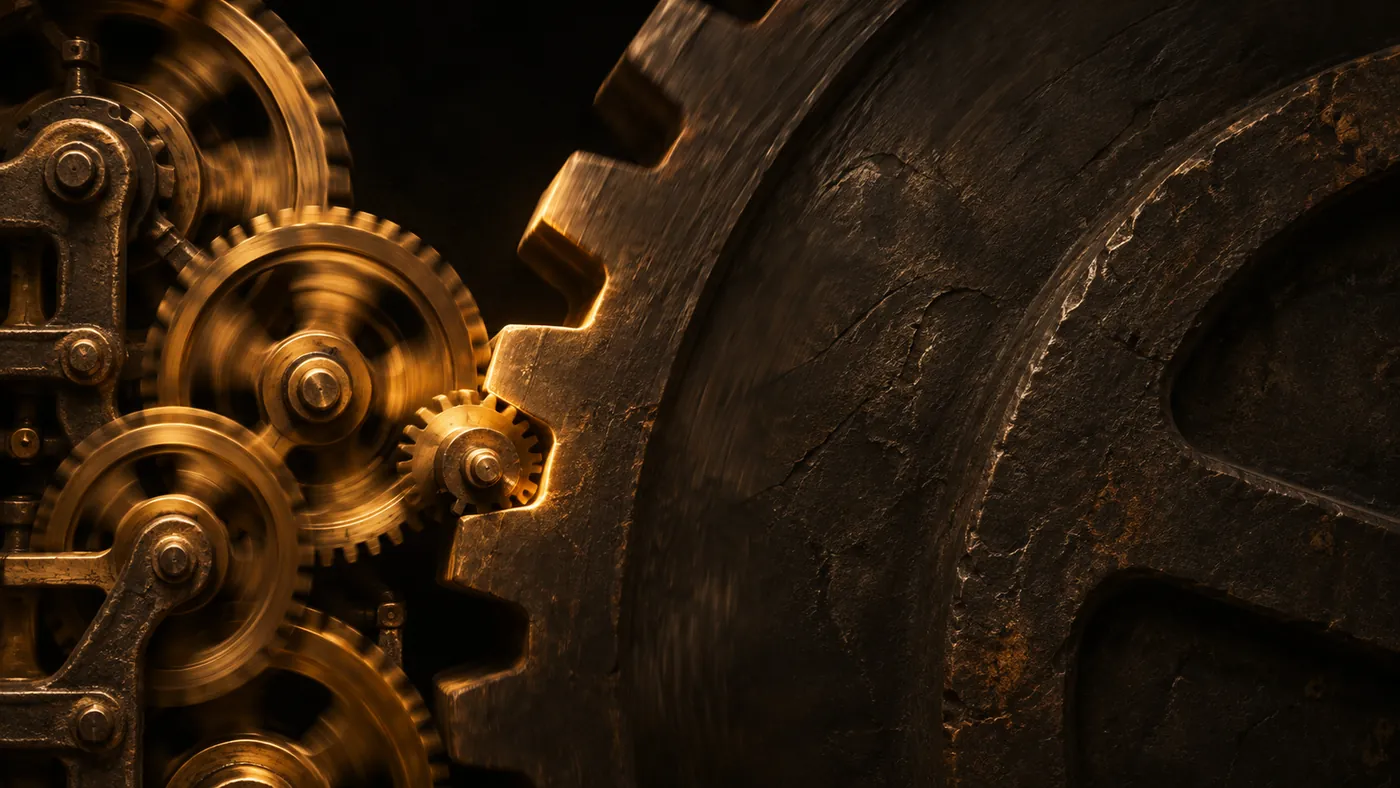
There is no steady state. There are only gears turning other gears.
Over the weekend I left a comment under a post about a bank research paper on superintelligence. It was serious work. But it reminded me of something I see in so many forecasts, in boardrooms and in macro models alike: disruption happens, the technology matures, the market digests the shock, and the line settles into a comfortable new slope.
Here is what I wrote: "So many of these prediction models somehow get to a sort of steady state. But recursive self-improving models will grow exponentially and will never stop. They will solve insolvable problems, and keep solving the next. There is no steady state. Imagine the penny doubling every day."
The honest case for a plateau
If I want to challenge my peers on this, I have to steelman them first.
Real curves stall. Every executive has lived through a technology cycle that promised transformation and delivered a software update. Pilots get stuck in compliance review. Utilities take years to approve new load. Drug candidates that look brilliant in simulation fail in people. If your mental model is built on S-curves, predicting a plateau isn't cynicism. It's pattern recognition.
We can even watch a stall in the AI adoption data. Graphite’s State of GenAI study, published November 9, 2026 and built on Similarweb estimates, found that worldwide sessions on the leading AI assistants grew only 2.3% between July and December 2025.[1]
Then the next gear caught. Since January 2026, sessions grew 19%, from 64 billion to 76 billion a month. By September the top six assistants were drawing about 76 billion sessions a month worldwide, up 37% year over year. Claude grew 1,901% year over year while ChatGPT still held 81.2% share. The whole pie got bigger. Over the same stretch, AI referral traffic grew 92% year over year, and Google's AI Overviews went from appearing in 23% of US searches in September 2025 to 64% by August 2026.[1]
I want to be careful about what that data is. Sessions are adoption. They don't prove recursive self-improvement, and they don't prove capabilities are doubling. Sessions are not unique users, and the figures come from one source using Similarweb estimates. Graphite itself says its growth by product is messy and hard to predict. But the shape is the lesson: a flat stretch was not the end of the story. It was a pause while torque built against the next gear.
So the serious question isn’t whether curves stall. They do. The question is whether the things causing the stall stay fixed while everything around them gets smarter.
Parallel is not simultaneous
Smart people talk past each other on AI because of one distinction: parallel is not simultaneous.
Both extremes get it wrong. The naive accelerationist talks as if superintelligence wakes up on a Tuesday and has cured every disease and rebuilt the grid by Friday. The skeptic points out, correctly, that you can't run a long biology study in an afternoon, concludes the accelerationist is a fantasist, and goes back to drawing a plateau.
Here's what actually happens. Thinking parallelizes almost instantly. Once a system can reason across math, code, molecules or engineering constraints, you can copy that capability across a data center and explore thousands of hypotheses at once. Building and testing run on physical clocks: fabs, labs, launch windows, transformers and transmission lines.
So the bottleneck moves, from ideas to physical throughput. For a while it can look like progress slowed, because designs queue up behind physical verification. That's the moment the skeptic calls a steady state. It's actually the moment the physical constraint becomes the most valuable target for that intelligence. Better simulations shrink what has to be tested physically. Better materials and catalysts make the physical steps faster. And recursive self-improving robots, which are in their infancy today, start to attack the physical clock directly.
That is a claim about direction, not something I can prove from a traffic chart. But it's a much harder claim to wave away than "everything gets solved at once," because it doesn't need everything at once. It only needs each limit to become the next problem in the queue, and each cycle to be a little shorter than the last.
Gears turning other gears
Picture a room full of clocks, with gears of every size. Digital intelligence is a cluster of tiny gears spinning fast. Manufacturing, biology and infrastructure are big cast-iron gears with a lot of inertia. At first the small gears strain against the big ones. Then the big ones start to move. A faster physical world builds more compute, gathers richer data and fabricates better robots, which spin up new gears.
Small gears speed up big ones. Big ones spin up new small ones. And they don’t stop.
Every industry has a heavy gear
You don’t have to work at a frontier lab to see this.
Payments and finance. The digital gear is already fast: risk, fraud and pricing in milliseconds. The heavy gears are compliance, legacy settlement rails and cross-border legal frameworks. Intelligence is starting to work on that friction.
Medicine. AI can propose candidate molecules in parallel. The heavy gear is the wet lab and the clinical trial. Automated labs that feed results back to models are an early version of the next gear. Biology still runs on cellular time, but the loop can tighten.
Energy and manufacturing. Skeptics love the grid as the hard stop. Compute needs power, and utilities move on permit timelines. Designing a lighter part takes minutes; retooling a line takes months. Both are heavy gears. The appetite for compute, and for robots that can help build the next generation of robots, puts pressure on intelligence to work those bottlenecks.
Materials, law, education and agriculture each have their own. These are directions I think are worth watching, not a claim that every industry will change at the same speed.
Even the biggest gear has smaller gears inside it
A few of us were talking about Dyson swarms recently: collectors capturing a fraction of the Sun's output, roughly 3.8 x 10^26 watts. The objections (manufacturing at scale, orbits, maintenance, cooling) are engineering bottlenecks, not laws of physics saying no. I'm not predicting when anyone builds one. I'm saying today's factories and launch systems are not permanent features of the universe.
A limit can be real and still be a gear. It can also turn out harder than we expect. We don’t get to call it solved before the work is done.
What this asks of us
I don't think this is comfortable. Faster cycles don't guarantee fair benefits, institutions that keep up, or wise choices. More capability means more choices, including ones we'll regret. That makes deciding what we want, and who gets a voice, more urgent, not less.
I also can’t tell you which bottleneck falls first, or exactly how fast. Anyone drawing a smooth line through every industry is claiming more than the evidence allows. But uncertainty about the path is not the same as confidence in a plateau.
My view: recursive self-improving AI, connected more and more to robots and the physical world, will keep turning today's limits into tomorrow's solved problems. Governments and bureaucracy can slow or redirect it. Physics matters. But our current understanding of physics, chemistry and biology has open questions, and better tools will work on those too. I think that drives exponential growth toward a singularity, and it's possible we're already in the early part of it, before the curve is obvious to the people living on it. That is my belief, not a conclusion established by the session numbers.
So if you lead a company, allocate capital or shape policy, the most dangerous cell in your spreadsheet may be the one that assumes things settle down.
Stop asking when AI reaches a steady state. Ask which immovable constraint in your industry is really just a heavy gear, and what your organization looks like when it starts to spin.
Remember the penny. Which day are we on?
There is no steady state. There are only gears turning other gears.
Sources
[1] Graphite, “The State of GenAI,” November 9, 2026 (Similarweb estimates): https://graphite.io/research/the-state-of-genai
-dg